author
Till Heinrichson loves to meet and engage with people of many different cultures, particularly in the Muslim world. Driven by the deep conviction that everyone in this world should hear of God’s love for them, he is passionate to share the stories of those who haven’t heard the good news – yet.
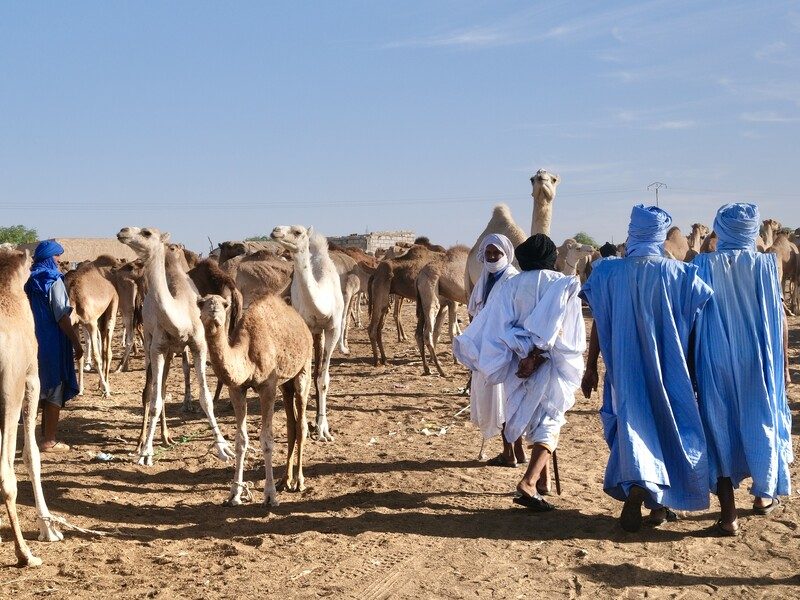
I stand in the warm morning sun at one of the largest camel markets in Africa on the sandy outskirts of Nouakchott, the capital city of Mauritania. Gazing over the heads and humps of thousands of dromedary camels, I can’t help but think about what Jesus said about the camel and the eye of the needle.
After a rich man turns away from Him, Jesus said: “Again I tell you, it is easier for a camel to go through the eye of a needle than for someone who is rich to enter the kingdom of God” (NIV). There is still much debate if Jesus was talking about an actual eye of a needle or perhaps a gate or a small door. The fact is, we know some rich people were following Him. So, even if rich people struggle more than others to follow Christ, there is the possibility for them to enter the Kingdom, or to stay in the metaphor — it is possible for the camel to go through the eye of the needle.
As it becomes clear to me that even the rich do have a chance to enter the Kingdom, it strikes me to think that the people of this land, rich or otherwise, seemingly have no chance to enter the Kingdom. They have plenty of camels, but there seems to be no eye of a needle to go through.
Life in this country is steeped in religion. Mosques big and small mark almost every street corner. As I wander the streets, I hear the chanting in the Qur’an schools; every neighbourhood seems to have one with children memorising the Qur’an and learning how to live as Muslims. This schooling shapes and dominates their entire life. As I look around, it’s obvious, most men and women follow a conservative Islamic dress code. When the call to prayer sounds five times a day, people take time to wash and prepare themselves for prayer. In the city, they use water to wash but, in the desert, I saw people take a handful of sand to clean their faces, hands and feet. A taxi driver tells me: “If there are neither water nor sand, I use a stone to clean myself for the ritual prayers.”
Following the rules and regulations of Islam is all that people seem to know — or are allowed to know, as it is illegal in Mauritania to invite people to join a different faith. For a Muslim to leave Islam comes with negative consequences, and for the very few foreigners in the country who follow Jesus, it is risky to share their faith. That leaves the vast majority of the 5 million people in Mauritania with almost no chance to ever hear the good news of how they can enter the Kingdom through Jesus.
Right as the call to prayer echoed through town, I asked a young man whom I had gotten to know: “Are you going to do your prayers now?” “No,” he stated emphatically, “Why should I pray?” He was struggling with the religion he was brought up in, but has had no chance to hear of the love of Christ.
But God makes a way where there is no way. At the end of my time in Mauritania, I met a woman who said: “I used to be a Muslim, but through the testimonies of Christians, I became a follower of Jesus.”
Mauritanians need to hear the good news from followers of Jesus going there to be a testimony for Christ.
Share On Your Socials