author
As a Malaysian, it was assumed and accepted that if you’re ethnically Chinese, you’d be a Taoist Buddhist; or a Muslim if you’re Malay; or a Hindu if you’re Indian. Christianity is typically seen as a foreign religion, and Christians are those who have had Western influence in their life – like having studied in the West. And, in collective cultures such as ours, personal choice of religion and conversion would have never crossed our minds – we follow the religion of our parents out of tradition and the expected filial piety.
Growing up as a Taoist-Buddhist, I would follow my parents to temples and perform certain rituals but I was mostly ignorant of their significance. It was not until I became a Christian when I learned more about this belief system that has more than one billion followers worldwide. I discovered that Buddhism is not merely a belief system or a religion but a worldview that has cultural and social implications. This is especially evident in countries like Thailand, Cambodia, Sri Lanka and even China where there has been a long history of Buddhist adherence. For instance, a Cambodian friend informed me that there is no word in Khmer that would aptly communicate the idea of the “mind.” This, I suspect, is a result of the entrenchment of the Buddhist (Theravada) doctrine that denies the existence of the soul.
Today, various forms of Buddhism are seeing a resurgence and there is unprecedented growth witnessed even in the West. With the influence of media and popular culture (for example, movies like The Matrix), increasingly more people are attracted to the Buddhist way in everything from personal growth to business practices.
This means our task to share the Gospel becomes all the more urgent and challenging. Hence, a better understanding of our Buddhist neighbors will help us to pray for them and to communicate the Gospel meaningfully to them.
So, what do Buddhists believe? With their belief in tolerance, non-violence and peace, shouldn’t we just leave them alone? Like most religions, Buddhism as a belief system, worldview and culture is extremely complex and exists in countless forms – differing in doctrine and practice – according to the schools, sects and geographical location.
Founded by Siddharta Gautama more than 2,000 years ago, Buddhism arose as a reform movement within Hinduism. The similarity between pantheistic Hinduism and Buddhism is the belief in one impersonal reality.
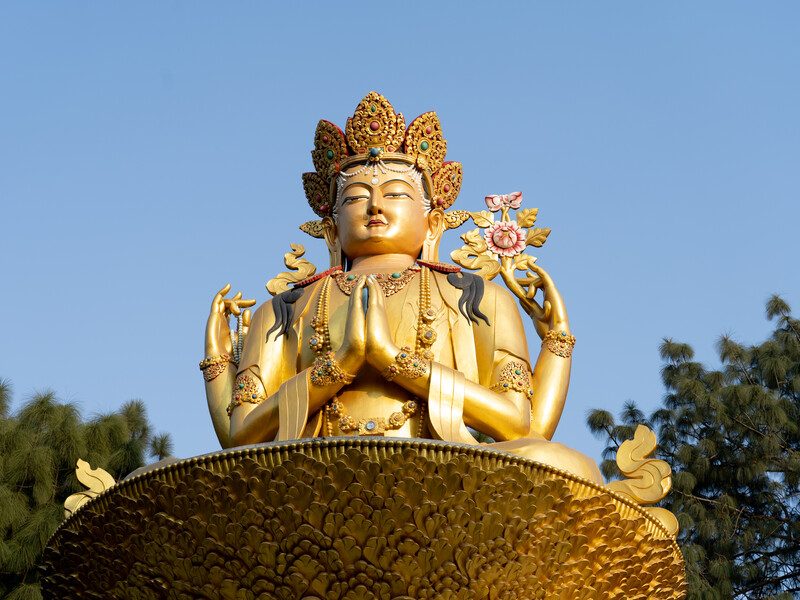
Though born a prince, Siddharta Gautama was plagued by the problem of suffering. As such, he left his family to pursue answers to the many questions he had about life. After a long mental struggle, he became the Buddha (“the enlightened one”) as he experienced insight and enlightenment under the bodhi tree (tree of enlightenment) while he was seated in a lotus position (hence the symbol of the lotus flower).
One of the reasons why Buddhism is so complex and diverse is that there are at least two branches of the religion and within them are scores of schools that hold to beliefs that appear contradictory. The two more significant branches are Theravada and Mahayana.
Though the expression and the practice of the various branches of Buddhism are so diverse, their core beliefs are still somewhat similar and can be summarized in the Four Noble Truths, the Noble Eightfold Path, and a few other key doctrines. The Four Noble Truths assert that
1.The universal existence of suffering
2.Suffering is caused by our cravings and desires of all kinds
3.Suffering will cease only when our cravings or desires cease
4.We can be liberated from suffering by following the Noble Eightfold Path
The Noble Eightfold Path is the Buddhist ethics that calls for moral and right living.
In most Buddhist societies, folk and animistic beliefs are also held alongside Buddha’s teachings. Spiritual beings believed to reside in nature (trees, rocks, etc) and “local gods” are worshipped or propitiated by lay adherents for worldly ends as the spirits are seen to be more interested with the practical concerns of life than the distant teachings of Buddha. This was evident in my family when we would typically label ourselves as Buddhists but in practice we were much more than that. In addition to fulfilling our duties at the Buddhist temple, we would also venerate various gods that bear little resemblance to Buddha.
Like everyone else, Buddhists are deeply concerned about the problem of suffering and attempt to overcome it by ceasing from desires. However, they live a contradiction, as the intention to cease from desiring is in itself a desire! Besides, the other solution to the problem of suffering, following the Eightfold Path, living a perfectly ethical life, is precisely our predicament – our incapacity for such endeavors. Rather, Christ is the answer to our problem of suffering. As we are incapable of freeing ourselves from suffering, Christ had suffered on our behalf so that we would be liberated.
In my family, traditions and cultural barriers could not keep the love of Jesus from breaking through – beginning with my mother’s brother. Today most of my mother’s family are followers of Jesus. This was a journey that spanned over decades for us and we are thankful to God for responding to our existential cries for purpose. However, many people from some form of Buddhist background are still looking for life’s meaning and purpose. So pray that God, in His mercy, love and power will break through entrenched cultural and religious barriers to welcome them into His Kingdom. And go to where our Buddhist neighbors are to witness the love of Christ to them.
I'Ching Chan-Thomas is an experienced apologetics speaker, with a specialisation in the relevancy of Christianity in the Eastern cultural context. Her book, Jesus: The Path to Human Flourishing (Graceworks, 2018), explores the commonalities between the gospel and Confucius’ ideal of human flourishing. I'Ching oversees the resourcing division of OM.
Brannigan, Michael C. The pulse of wisdom: the philosophies of India, China, and Japan. Wadsworth, 1995.
Burnett, David. Clash of Worlds. Monarch Books, 2002.
Corduan, Winfried. A Tapestry of Faiths. IVP, 2002.
Corduan, Winfried. Neighboring Faiths: A Christian Introduction to World Religions. IVP, 1998.
Hock, David Tey. Chinese Culture and the Bible. Here’s Life Books, 1988.
Yamamoto, J. Isamu. Beyond Buddhism: A Basic Introduction to the Buddhist tradition. IVP, 1982.
Share On Your Socials

Rebecca and Renette share what 2020 taught them in a 'thank you' letter to the year.

After experiencing God provide through prayer, Peter embarks on a global journey of praying for the nations and leading others in that process.
After Bible School David and Adèle understood God tell them to wait, and so, they actively waited as they sought His direction.

Seeing people put into practice what they’ve learnt to start their own businesses and then “at the end of the day, they’re actually able to be self-sustainable and provide for their families” is one of Jacob’s favourite aspects of the training.

In this month's Director's Update, read Lawrence Tong's article about how we must bridge the sacred-secular divide not just in our ministries but also in our minds.

Hasan's method to live out Christ’s love on the football field in southern Africa is simple: ‘pray, play and say.’
Through repeat visits to a West African port, OM’s Ship Ministry partners with a local pastor for ongoing impact and community transformation.

"Today, it is still the ‘OM way’ to welcome people who want to love God and love others around the world, equipping them with the knowledge, skills and attitudes they need to thrive in mission," Tami says.

Paul shares what fuelled his motivation to support believers in areas of Asia where it is hard to follow Jesus. He hopes their stories will inspire someone to catch the vision for helping equip the church in this region.

More Muslims have come to faith in the last 30 years than in all of previous history – and prayer has been a central part of that work.

The call to keep calm and carry on is apt for us as we continue our journey that is punctuated with changes and transitions